
Nissan Sentra Service Manual: Exhaust valve timing control
EXHAUST VALVE TIMING CONTROL : System Description
SYSTEM DIAGRAM
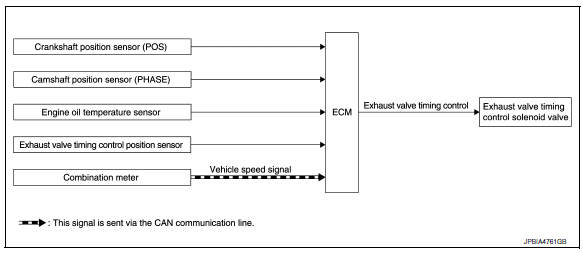
INPUT/OUTPUT SIGNAL CHART
| Sensor | Input signal to ECM | ECM function | Actuator | |
| Crankshaft position sensor (POS) | Engine speed and piston position | Exhaust valve timing control | Exhaust valve timing control solenoid valve | |
| Camshaft position sensor (PHASE) | ||||
| Engine oil temperature sensor | Engine oil temperature | |||
| Exhaust valve timing control position sensor | Exhaust valve timing signal | |||
| Combination meter | CAN communication | Vehicle speed signal | ||
SYSTEM DESCRIPTION
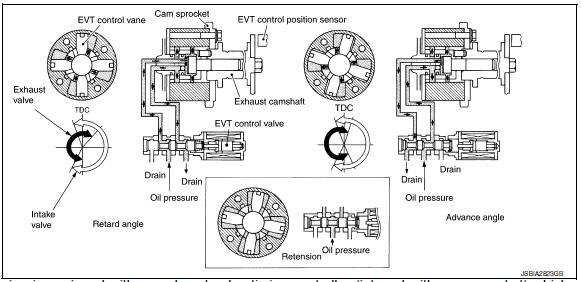
This engine is equipped with an exhaust valve timing controller (integral with cam sprocket) which continuously adjusts the phase of intake valve according to driving conditions, improves both low/mid range engine torque and high-speed range engine output, and brings about low emission and low fuel consumption.
The exhaust valve timing control system continuously controls cam phases in constant exhaust valve operating angle conditions and adjusts an operating oil pressure to the exhaust valve timing controller via the control solenoid valve.
ECM receives exhaust valve timing control position signal, crankshaft position signal, engine speed signal, engine oil temperature signal, and engine coolant temperature signal. And the ECM outputs ON/OFF pulse duty signals to the exhaust valve timing control solenoid valve depending on driving status.
Exhaust Valve Timing Controller Operation List
| Exhaust valve timing solenoid valve condition | Exhaust valve timing controller operation |
| Engine OFF | When starting the engine, the controller vane and sprocket are fixed in full retard position by the reaction force of return spring, improving the starting performance of the engine. |
| Active (Retard angle) | When the energization rate to the control solenoid valve is
increased, the oil pressure from the oil
pump is conveyed to the retard angle chamber of the controller. And
advance angle chamber oil is
drained. Accordingly, the controller vane rotates leftward and the phase
of camshaft becomes retard
angle.
This condition brings about the greater overlap with the exhaust valve, enabling the exhaust gas cleaning by the internal EGR effect and the fuel consumption improvement by the reduction in pumping loss. |
| Neutral (Maintained) | When it is the target valve timing, the energization rate to the control solenoid valve is adjusted to the intermediate state. The solenoid valve is positioned at the neutral position and the oil path is interrupted to maintain the cam shaft phase. |
| Return (Advance angle) | When the energization rate to the control solenoid valve is
decreased, the oil pressure from the oil
pump is conveyed to the advance angle chamber of the controller. And
retard angle chamber oil is
drained.
Accordingly, the controller vane rotates rightward and the phase of camshaft becomes advance angle. |
EXHAUST VALVE TIMING CONTROL FEEDBACK CONTROL
Cam Position Detection
The exhaust valve control position sensor mounted at the rear of the cylinder head detects a cam position, by using the groove on the plate located at the rear of the intake camshaft.
Feedback Control
The exhaust valve control position sensor feeds back an actual cam position signal to ECM. Based on the signal, ECM controls the exhaust valve timing control solenoid valve to satisfy the optimum target valve opening/ closing timing according to a driving condition.
 Intake valve timing control
INTAKE VALVE TIMING CONTROL : System Description
SYSTEM DIAGRAM
INPUT/OUTPUT SIGNAL CHART
Sensor
Input signal to ECM
ECM function
Actuator
Crankshaft position sensor (P ...
 Intake manifold runner control
INTAKE MANIFOLD RUNNER CONTROL : System
Description
SYSTEM DIAGRAM
SYSTEM DESCRIPTION
Intake manifold runner control valve has a valve portion in the intake
passage of each cylinder.
Whil ...
Other materials:
Timing chain
Exploded View
Timing chain slack guide
Timing chain tensioner
Timing chain
Oil pump drive chain
Crankshaft sprocket
Crankshaft key
Oil pump sprocket
Front cover
O-ring
O-ring
Valve timing control solenoid valve cover
O-ring
Valve timing control solenoid valve
(EXH)
...
Environmental factors influence the rate of corrosion
Moisture
Accumulation of sand, dirt and water on the vehicle
body underside can accelerate corrosion.
Wet floor coverings will not dry completely inside
the vehicle and should be removed for drying to
avoid floor panel corrosion.
Relative humidity
Corrosion will be accelerated in areas of h ...
Condenser
Exploded view
Core support upper cover
High-pressure pipe
High-pressure flexible hose
Refrigerant pressure sensor
Condenser and liquid tank assembly
Core support upper
Front
Condenser
Condenser : removal and installation
REMOVAL
Discharge the refrigerant. Refer to HA-23, & ...
