
Nissan Sentra Service Manual: Basic inspection
Diagnosis and repair workflow
Work Flow
Detailed flow
1.Interview from the customer
Clarify customer complaints before inspection. First of all, perform an interview utilizing stc-20, "diagnostic work sheet" and reproduce symptoms as well as fully understand it. Ask customer about his/her complaints carefully. Check symptoms by driving vehicle with customer, if necessary.
Caution:
Customers are not professional. Never guess easily like “maybe the customer means that...,” Or “maybe the customer mentions this symptom”.
>> Go to 2.
2.Check symptom
Reproduce the symptom that is indicated by the customer, based on the information from the customer obtained by interview. Also check that the symptom is not caused by protection function. Refer to STC-13, "Protection Function".
Caution:
When the symptom is caused by normal operation, fully inspect each portion and obtain the understanding of customer that the symptom is not caused by a malfunction.
>> Go to 3.
3.Perform self-diagnosis
 With consult
Perform self-diagnosis.
Is any dtc detected? Yes >> record or print dtc and freeze frame data (ffd). Go to 4.
No >> go to 6.
4.Recheck symptom
 With consult
-
Erase self-diagnostic results.
-
Perform dtc confirmation procedures for the malfunctioning system.
Note:
If some DTCs are detected at the same time, determine the order for performing the diagnosis based on STC- 14, "DTC Inspection Priority Chart".
Is any dtc detected? Yes >> go to 5.
No >> check harness and connectors based on the information obtained by interview. Refer to gi-39, "intermittent incident".
5.Repair or replace malfunctioning parts
-
Repair or replace malfunctioning parts
-
Reconnect part or connector after repairing or replacing.
-
When dtc is detected, erase self-diagnostic results for “eps”.
>> Go to 7.
6.Identify malfunctioning system by symptom diagnosis
Estimate malfunctioning system based on symptom diagnosis and perform inspection.
Can the malfunctioning system be identified?
Yes >> go to 7.
No >> check harness and connectors based on the information obtained by interview. Refer to gi-39, "intermittent incident".
7.Final check
 With consult
-
Check the reference value for eps control unit.
-
Recheck the symptom and check that symptom is not reproduced on the same conditions.
Is the symptom reproduced? YES >> GO TO 3.
NO >> Inspection End.
Diagnostic Work Sheet
Description
-
In general, customers have their own criteria for a problem. Therefore, it is important to understand the symptom and status well enough by asking the customer about his/her concerns carefully. To systemize all the information for the diagnosis, prepare the interview sheet referring to the interview points.
-
In some cases, multiple conditions that appear simultaneously may cause a dtc to be detected.
Interview sheet sample
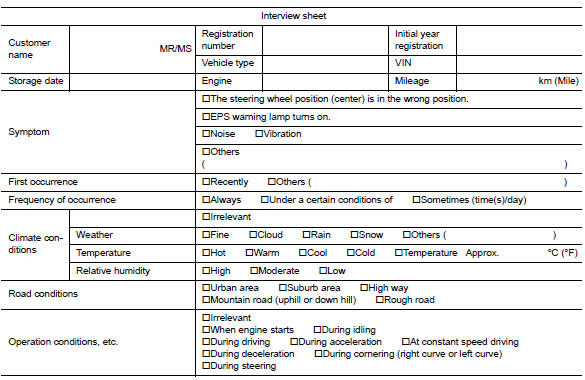
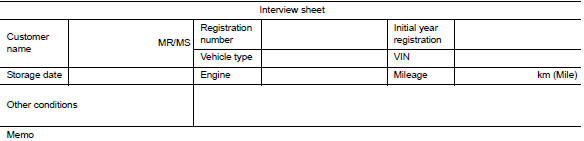
 Wiring diagram
Power steering control system
Wiring Diagram
...

Other materials:
General maintenance
During the normal day-to-day operation of the
vehicle, general maintenance should be performed
regularly as prescribed in this section. If
you detect any unusual sounds, vibrations or
smells, be sure to check for the cause or have a
NISSAN dealer do it promptly. In addition, you
should notify ...
Precaution for Work
When removing or disassembling each component, be careful not to damage
or deform it. If a component
may be subject to interference, be sure to protect it with a shop cloth.
When removing (disengaging) components with a screwdriver or similar
tool, be sure to wrap the component
with a ...
License plate lamp
Removal and Installation
REMOVAL
Remove the license lamp finisher. Refer to EXT-44, "Removal and
Installation".
Disconnect the harness connector (A) from the license plate
lamp (1).
Release pawl and remove.
: Pawl
INSTALLATION
Installation is in the reverse order of ...
