
Nissan Sentra Service Manual: Brake master cylinder
Exploded View
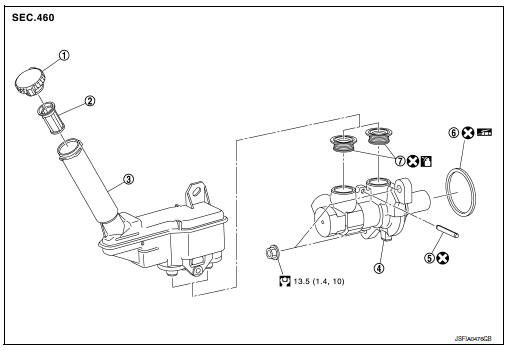
- Reservoir cap
- Oil strainer
- Reservoir tank
- Cylinder body
- Pin
- O-ring
- Grommet
 Apply brake fluid
 PBC (Poly Butyl Cuprysil)
grease or
silicone-based grease
Removal and Installation
REMOVAL
CAUTION:
- Do not spill or splash brake fluid on painted surfaces. Brake fluid may damage paint. If brake fluid is splashed on painted areas, wash it away with water immediately.
- Do not scratch the piston of master cylinder when installing/removing because the piston is exposed. Check for any dust on the piston, and wash with brake fluid if needed.
- Hold the master cylinder body when handing the master cylinder assembly. Do not hold the piston because the piston might become detached if pulled strongly.
- Refill the reservoir tank with new brake fluid “DOT 3”.
- Do not reuse drained brake fluid.
- Do not reuse master cylinder O-ring.
NOTE:
When removing components such as hoses, tubes/lines, etc., cap or plug openings to prevent fluid from spilling.
- Partially drain brake fluid. Refer to BR-17, "Drain and Refill".
- Disconnect the harness connector from the brake fluid level switch.
- Remove air duct and air cleaner case. Refer to EM-25, "Removal and Installation".
- Remove the engine room insulator and position aside.
- Separate the brake tube from master cylinder assembly with a suitable tool.
CAUTION:
Do not scratch the flare nut and the brake tube.
- Disconnect the clutch hose (if equipped).
- Remove the master cylinder assembly.
CAUTION:
- Do not deform or bend the brake tubes.
- Do not depress the brake pedal after the master cylinder assembly is removed.
- The piston of the master cylinder assembly is exposed. Do not damage the piston when removing the master cylinder.
- The piston may drop off when pulled out strongly. Do not hold the piston. Hold the cylinder body when handling the master cylinder assembly.
- Remove and discard the O-ring.
CAUTION:
Do not reuse O-ring.
INSTALLATION
Installation is in the reverse order of removal.
CAUTION:
Do not reuse O-ring.
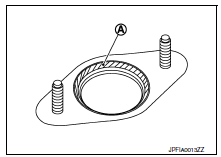
- Apply PBC (Poly Butyl Cuprysil) grease or equivalent to the brake booster (A) when installing the master cylinder assembly to the brake booster.
- Temporarily tighten the brake tube flare nut to the master cylinder assembly by hand. Then tighten it to the specified torque.Refer to BR-25, "FRONT : Exploded View".
- Perform the air bleeding. Refer to BR-17, "Bleeding Brake System".
 Brake piping
FRONT
FRONT : Exploded View
Brake tube
ABS actuator and electric unit (control
unit)
Connector
Connector bracket
Master cylinder assembly
Brake booster
Lock plate
Brake hose
...
 Brake booster
Exploded View
Master cylinder assembly
Brake booster
Lock nut
Clevis
Gasket
Spacer
Removal and installation
REMOVAL
Remove cowl top and cowl top extension. Refer to EXT-26, ...
Other materials:
Can communication
CAN COMMUNICATION : System Description
CAN (Controller Area Network) is a serial communication line for real time
application. It is an on-vehicle multiplex
communication line with high data communication speed and excellent error
detection ability. Many electronic
control units are equipped ...
Vehicle recovery (freeing a stuck vehicle)
Front (if so equipped)
Do not use the hook to tow the vehicle.
Remove the cover bumper bracket using a
flat screwdriver or any flat tool.
To protect the bumper body, place a piece of
cloth between the tool and the vehicle.
The tool used should be inserted by the
lower portion of t ...
P0705 Transmission range sensor A
DTC Logic
DTC DETECTION LOGIC
DTC
CONSULT screen terms
[Trouble diagnosis content]
DTC detection condition
Possible causes
P0705
T/M RANGE SENSOR A
[Transmission Range Sensor
A Circuit (PRNDL Input)]
Two or more range signals simultaneously
stay ON conti ...
