
Nissan Sentra Service Manual: Wheel alignment
Inspection
DESCRIPTION
Measure the wheel alignment under unladen conditions.
NOTE:
“Unladen conditions” means that fuel, engine coolant, and lubricants are full. Spare tire, jack, hand tools and mats are in designated positions.
PRELIMINARY
Check the following:
- Tires for improper air pressure and wear.
- Road wheels for runout. Refer to WT-46, "Inspection".
- Wheel bearing axial end play. Refer to RAX-5, "Inspection".
- Shock absorber operation.
- Each mounting part of suspension for looseness and deformation.
- Rear suspension beam for cracks, deformation, and other damage.
- Vehicle height (posture).
GENERAL INFORMATION AND RECOMMENDATIONS
- A Four-Wheel Thrust Alignment should be performed.
- This type of alignment is recommended for any NISSAN vehicle.
- The four-wheel “thrust” process helps ensure that the vehicle is properly aligned and the steering wheel is centered.
- The alignment machine itself should be capable of accepting any NISSAN vehicle.
- The alignment machine should be checked to ensure that it is level.
- Make sure the alignment machine is properly calibrated.
- Your alignment machine should be regularly calibrated in order to give correct information.
- Check with the manufacturer of your specific alignment machine for their recommended Service/Calibration Schedule.
THE ALIGNMENT PROCESS
IMPORTANT:
Use only the alignment specifications listed in this Service Manual. Refer to RSU-15, "Wheel Alignment (Unladen*1)".
- When displaying the alignment settings, many alignment machines use “indicators”: (Green/red, plus or minus, Go/No Go). Do NOT use these indicators.
- The alignment specifications programmed into your alignment machine that operate these indicators may not be correct.
- This may result in an ERROR.
- Most camera-type alignment machines are equipped with both "Rolling
Compensation" method and
optional "Jacking Compensation" method to "compensate" the alignment targets
or head units.
"Rolling Compensation" is the preferred method.
- If using the "Rolling Compensation" method, after installing the alignment targets or head units, push or pull on the rear wheel to move the vehicle. Do not push or pull the vehicle body.
- If using the "Jacking Compensation" method, after installing the alignment targets or head units, raise the vehicle and rotate the wheels 1/2 turn both ways.
NOTE:
Do not use the "rolling compensation" if you are using sensor-type alignment equipment.
- Follow all instructions for the alignment machine you're using for more information.
CAMBER INSPECTION
- Measure camber of both right and left wheels with a suitable alignment gauge.
Camber : Refer to RSU-15, "Wheel Alignment (Unladen*1)".
- If it is out of the specification value, inspect and replace any damaged or worn rear suspension parts.
TOTAL TOE-IN INSPECTION
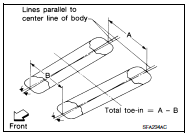
Measure the total toe-in using following procedure. If it is out of the specification, inspect and replace any damaged or worn rear suspension parts.
WARNING:
- Always perform the following procedure on a flat surface.
- Make sure that no person is in front of the vehicle before pushing it.
- Bounce the rear of the vehicle up and down to stabilize the vehicle height (posture).
- Push the rear wheel to move the vehicle straight ahead about 5 m (16 ft).
- Put a mark on the base line of the tread (rear side) of both tires at the same height of hub center. These are measuring points.
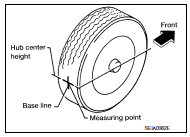
- Measure the distance (A) from the rear side.
- Push the rear wheel to move the vehicle slowly ahead and to rotate the wheels 180 degrees (1/2 turn).
CAUTION:
If the wheels have rotated more than 180 degrees (1/2 turn), try the above procedure again from the beginning. Do not push the vehicle backward.
- Measure the distance (B) from the front side.
Total toe-in : Refer to RSU-15, "Wheel Alignment (Unladen*1)".
 Rear suspension assembly
Inspection
COMPONENT PART
Check the mounting conditions (looseness, backlash) of each component. Verify
the component conditions
(wear, damage) are normal.
SHOCK ABSORBER
Check the shock absorb ...

Other materials:
Basic inspection
Diagnosis and repair workflow
Work Flow
OVERALL SEQUENCE
DETAILED FLOW
1. OBTAIN INFORMATION ABOUT SYMPTOM
Interview the customer to obtain as much information as possible about the
conditions and environment under
which the malfunction occurred.
>> GO TO 2.
2. CONFIRM THE SYMPTO ...
System
System Diagram
System Description
FRONT WIPER CONTROL (BASIC)
BCM detects the combination switch position by the combination switch
reading function.
BCM transmits the front wiper request signal to the IPDM E/R using CAN
communication.
IPDM E/R controls the integrated front wipe ...
Pregnant women
NISSAN recommends that pregnant women use
seat belts. The seat belt should be worn snug and
always position the lap belt as low as possible
around the hips, not the waist. Place the shoulder
belt over your shoulder and across your chest.
Never run the lap/shoulder belt over your abdominal
ar ...
