
Nissan Sentra Owners Manual: Battery
- Keep the battery surface clean and dry.
Clean the battery with a solution of baking soda and water.
- Make certain the terminal connections are clean and securely tightened.
- If the vehicle is not to be used for 30 days or longer, disconnect the negative (-) battery terminal cable to prevent discharge.
NOTE:
Care should be taken to avoid situations that can lead to potential battery discharge and potential no-start conditions such as:
- Installation or extended use of electronic accessories that consume battery power when the engine is not running (Phone chargers, GPS, DVD players, etc.)
- Vehicle is not driven regularly and/or only driven short distances. In these cases, the battery may need to be charged to maintain battery health.
WARNING
|
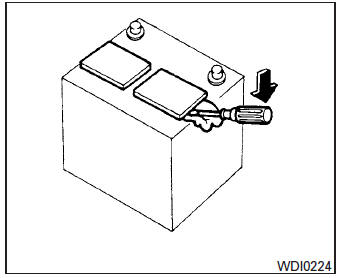
- Remove the vent caps with a screwdriver as shown. Use a cloth to protect the battery case.
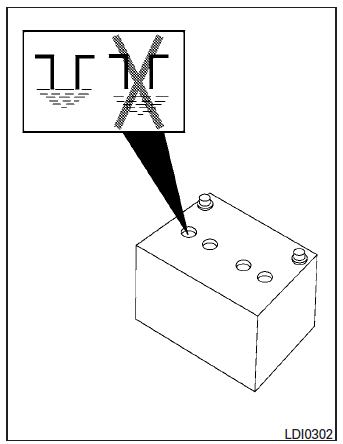
- Check the fluid level in each cell. If it is necessary to add fluid, add only distilled water to bring the level up to the bottom of the filler opening. Do not overfill. Reinstall the vent caps.
Vehicles operated in high temperatures or under severe conditions require frequent checks of the battery fluid level.
JUMP STARTING
If jump starting is necessary, see “Jump starting� in the “In case of emergency� section of this manual. If the engine does not start by jump starting, the battery may have to be replaced.
Contact a NISSAN dealer.
 Windshield-washer fluid
Windshield-washer fluid reservoir
Fill the windshield-washer fluid reservoir periodically.
To fill the windshield-washer fluid reservoir, lift
the cap off the reservoir and pour the windshiel ...
 Variable voltage control system
CAUTION
Do not ground accessories directly to
the battery terminal. Doing so will bypass
the variable voltage control system
and the vehicle battery may not
charge completely.
Use el ...
Other materials:
Rear seat
Exploded View
Rear seatback assembly (rh)
Seatback striker
Seatback latch release knob
Seatback latch assembly
Seatback silencer (RH)
Rear seatback frame (rh)
Seatback latch release knob finisher
Rear seat bolster trim (RH)
Rear seat bolster pad (RH)
Rear seat bolster (rh)
...
Trunk room trim
Exploded View
Trunk floor trim
Trunk front floor spacer (LH)
Trunk side finisher (LH)
Reflector box assembly*
Trunk rear plate
Trunk side finisher (RH)
Trunk front floor spacer (RH)
Clip
Pawl
Trunk rear plate
TRUNK REAR PLATE : Removal and Installation
REMOVAL
Remove ...
Tilt operation
Pull the lock lever down 1 and adjust the steering
wheel up or down 2 to the desired position.
Push the lock lever up 1 firmly to lock the
steering wheel in place.
WARNINGDo not adjust the steering wheel while
driving. You could lose control of your
vehicle and cause an accide ...
