
Nissan Sentra Service Manual: Basic inspection
Diagnosis and repair workflow
Work flow
Overall sequence
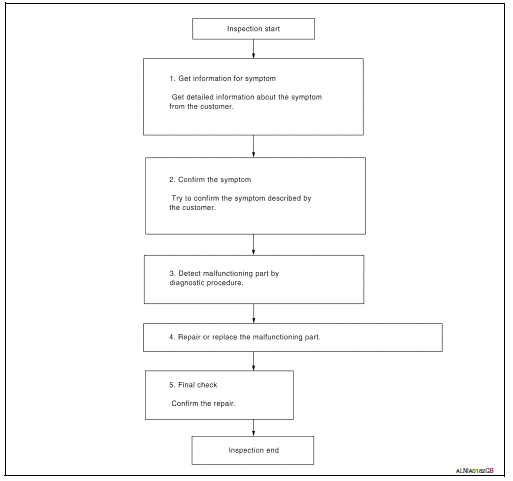
Detailed flow
1.Get information for symptom
Get detailed information from the customer about the symptom (the condition and the environment when the incident/malfunction occurred).
>> Go to 2
2.Confirm the symptom
Try to confirm the symptom described by the customer. Verify relation between the symptom and the condition when the symptom is detected.
>> GO TO 3
3.Detect malfunctioning part by diagnostic procedure
Inspect according to diagnostic procedure of the system.
Is malfunctioning part detected? YES >> GO TO 4
No >> go to 2
4.Repair or replace the malfunctioning part
- Repair or replace the malfunctioning part.
- Reconnect parts or connectors disconnected during diagnostic procedure.
>> GO TO 5
5.Final check
Refer to confirmed symptom in step 2, and make sure that the symptom is not detected.
Was the repair confirmed? Yes >> inspection end.
No >> go to 2
 Wiring diagram
Display audio with bose
Wiring diagram
...
 Dtc/circuit diagnosis
Power supply and ground circuit
Audio unit
Audio unit : diagnosis procedure
Regarding Wiring Diagram information, refer to AV-157, "Wiring Diagram".
1.Check fuse
Are the fuses blown?
...
Other materials:
Symptom diagnosis
Squeak and rattle trouble diagnoses
Work Flow
CUSTOMER INTERVIEW
Interview the customer if possible, to determine the conditions that exist
when the noise occurs. Use the Diagnostic
Worksheet during the interview to document the facts and conditions when the
noise occurs and any
custome ...
Slip indicator lamp
Component Function Check
1.CHECK SLIP INDICATOR LAMP FUNCTION
Check that slip indicator lamp in combination meter turns ON for
approximately 2 seconds after ignition switch
is turned ON.
Is the inspection result normal?
YES >> Inspection End.
NO >> Proceed to diagnosis proce ...
Ecu diagnosis information
Bcm (body control module)
List of ecu reference
Moonroof motor assembly
Reference value
Terminal layout
Physical values
...
