
Nissan Sentra Owners Manual: Tire pressure
Tire Pressure Monitoring System (TPMS)
This vehicle is equipped with the Tire Pressure Monitoring System (TPMS). It monitors tire pressure of all tires except the spare. When the low tire pressure warning light is lit and the CHECK TIRE PRES warning is displayed in the odometer, one or more of your tires is significantly under-inflated.
The TPMS will activate only when the vehicle is driven at speeds above 16 MPH (25 km/h). Also, this system may not detect a sudden drop in tire pressure (for example a flat tire while driving).
For more details, refer to “Low tire pressure warning light� in the “Instruments and controls� section, “Tire Pressure Monitoring System (TPMS)� in the “Starting and driving� section, and “Flat tire� in the “In case of emergency� section.
Tire inflation pressure
Check the tire pressures (including the spare) often and always prior to long distance trips. The recommended tire pressure specifications are shown on the F.M.V.S.S./C.M.V.S.S. certification label or the Tire and Loading Information label under the “Cold Tire Pressure� heading.
The Tire and Loading Information label is affixed to the driver side center pillar. Tire pressures should be checked regularly because:
- Most tires naturally lose air over time.
- Tires can lose air suddenly when driven over potholes or other objects or if the vehicle strikes a curb while parking.
The tire pressures should be checked when the tires are cold. The tires are considered COLD after the vehicle has been parked for 3 or more hours, or driven less than 1 mile (1.6 km) at moderate speeds.
The “TPMS with Easy Fill Tire Alert� provides visual and audible signals outside the vehicle for inflating tires to the recommended COLD tire pressure. For more information, see “TPMS with Easy Fill Tire Alert� in the “Starting and driving� section.
Incorrect tire pressure, including under inflation, may adversely affect tire life and vehicle handling.
WARNING
|
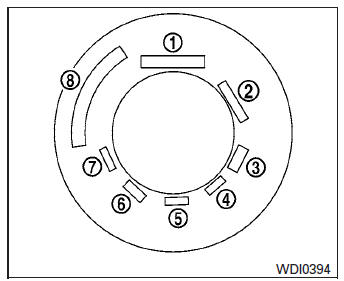
Tire and loading information label
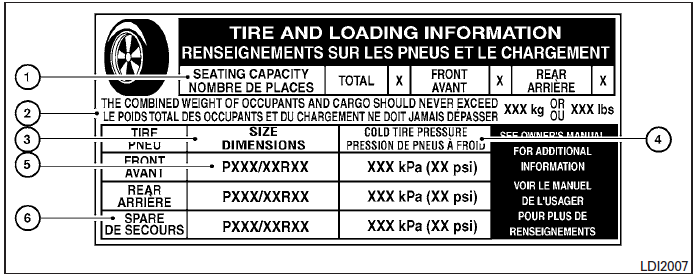
- Seating capacity: The maximum number of occupants that can be seated in the vehicle.
- Vehicle load limit: See “Vehicle loading information� in the “Technical and consumer information� section.
- Original tire size: The size of the tires originally installed on the vehicle at the factory.
- Cold tire pressure: Inflate the tires to
this pressure when the tires are cold.
Tires are considered COLD after the vehicle has been parked for 3 or more hours, or driven less than 1 mile (1.6 km) at moderate speeds. The recommended cold tire inflation is set by the manufacturer to provide the best balance of tire wear, vehicle handling, driveability, tire noise, etc., up to the vehicle’s GVWR.
- Tire size – refer to “Tire labeling� in this section.
- Spare tire size.
Checking tire pressure
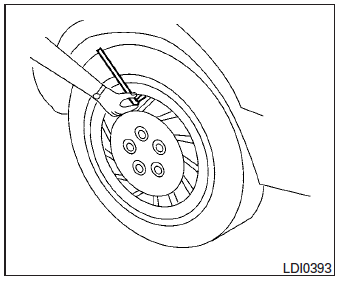
- Remove the valve stem cap from the tire.
- Press the pressure gauge squarely onto the valve stem. Do not press too hard or force the valve stem sideways, or air will escape. If the hissing sound of air escaping from the tire is heard while checking the pressure, reposition the gauge to eliminate this leakage.
- Remove the gauge.
- Read the tire pressure on the gauge stem and compare to the specification shown on the Tire and Loading Information label.
- Add air to the tire as needed. If too
much air is added, press the core of
the valve stem briefly with the tip of
the gauge stem to release pressure.
Recheck the pressure and add or release air as needed.
- Install the valve stem cap
- Check the pressure of all other tires, including the spare.
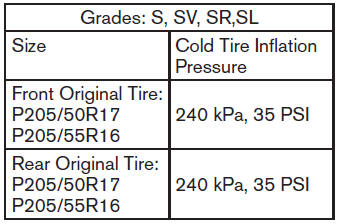
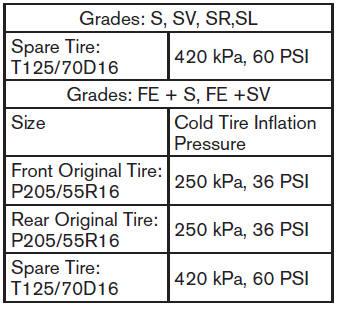
Example
 Wheels and tires
If you have a flat tire, see “Flat tire� in the
“In case of emergency� section of this
manual. ...
 Tire labeling
Federal law requires tire manufacturers to
place standardized information on the
sidewall of all tires. This information identifies
and describes the fundamental
characteristics of the tire and al ...
Other materials:
Towing a trailer
Do not tow a trailer with your vehicle.
Flat towing
Towing your vehicle with all four wheels on the
ground is sometimes called flat towing. This
method is sometimes used when towing a vehicle
behind a recreational vehicle, such as a motor
home.
CAUTION
Failure to follow these guidelines c ...
Help voice commands
The following voice commands can be spoken to
have the system provide instructions and tips for
using the NISSAN Voice Recognition system.
List Commands
What Can I Say?
General Help
Quit
Exit
Symptom/error message
Solution
The system responds “Command Not
Rec ...
Body sealing
Description
The following figure shows the areas which are sealed at the factory. Sealant
which has been applied to these
areas should be smooth and free from cuts or gaps. Care should be taken not to
apply an excess amount of
sealant and not to allow other unaffected parts to come into conta ...
