
Nissan Sentra Owners Manual: Continuously Variable Transmission (CVT) (if so equipped)
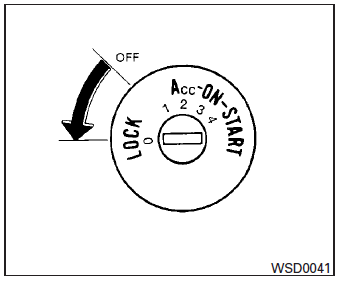
The ignition lock is designed so that the ignition switch cannot be turned to the LOCK position until the shift lever is moved to the P (Park) position.
- When moving the ignition switch to the LOCK position, make sure the shift lever is in the P (Park) position.
- When removing the key from the ignition switch, make sure the shift lever is in the P (Park) position.
When the ignition switch cannot be turned to the LOCK position:
- Shift the shift lever to the P (Park) position.
- Turn the ignition switch slightly in the ON direction.
- Turn the ignition switch to the LOCK position.
- Remove the key if it is inserted in the ignition switch.
If the ignition switch is turned to the LOCK position, the shift lever cannot be moved from the P (Park) position.
The shift lever can be moved if the ignition switch is placed in the ON position and the foot brake pedal is depressed.
There is an OFF position between the LOCK and ACC positions. The OFF position is indicated by a “1� on the key cylinder.
 Ignition switch (if so equipped)
WARNING
Never remove or turn the key to the
LOCK position while driving. The steering
wheel will lock (for models with a
steering lock mechanism). This may
cause the driver ...
 Manual transmission (if so equipped)
The ignition switch includes a device that helps
prevent accidental removal of the key while driving.
The key can only be removed when the ignition
switch is in the LOCK position.
On manua ...
Other materials:
Voice commands
Voice commands can be used to operate the
Bluetooth® Hands-Free Phone System. Press
the button and say “Phone� to bring
up the
phone command menu. The available options
are:
Call
Phonebook
Recent Calls
Send Text
Read Text
Select Phone
“Call�
For more information on ...
Refrigeration system symptoms
Trouble diagnosis for unusual pressure
Diagnose using a manifold gauge whenever system’s high and/or low side
pressure(s) is/are unusual. The
marker above the gauge scale in the following tables indicates the standard
(usual) pressure range. Refer to
above table (Ambient air temperature ...
Rapid air pressure loss
Rapid air pressure loss or a “blow-out� can occur
if the tire is punctured or is damaged due to
hitting a curb or pothole. Rapid air pressure loss
can also be caused by driving on under-inflated
tires.
Rapid air pressure loss can affect the handling
and stability of the vehicle, especially ...
