
Nissan Sentra Service Manual: Compression pressure
Inspection
- Warm up the engine to full operating temperature.
- Release fuel pressure. Refer to EC-143, "Work Procedure".
- Remove ignition coil and spark plug from each cylinder. Refer to EM-46, "Exploded View".
- Connect engine tachometer (not required in use of CONSULT).
- Install compression gauge (B) with an adapter (A) into spark plug hole.
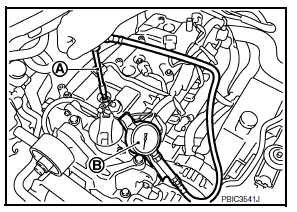
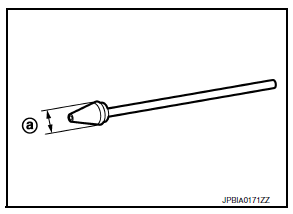
- Use the adapter whose pick up end inserted to spark plug hole is smaller than 20 mm (0.79 in) in diameter. Otherwise, it may be caught by cylinder head during removal.
(a) : 20 mm (0.79 in) or less
- With accelerator pedal fully depressed, turn ignition switch to “START” for cranking. When the gauge pointer stabilizes, read the compression pressure and the engine rpm. Perform these steps to check each cylinder.
Compression pressure : Refer to EM-118, "General Specification".
CAUTION:
Always use a fully charged battery to obtain the specified engine speed.
- If the engine speed is out of the specified range, check battery liquid for proper gravity. Check the engine speed again with normal battery gravity.
- If compression pressure is below minimum value, check valve clearances, and parts associated with combustion chamber (valve, valve seat, piston, piston ring, cylinder bore, cylinder head, and cylinder head gasket). After checking, measure compression pressure again.
- If some cylinder has low compression pressure, pour small amount of engine oil into the spark plug hole of the cylinder to recheck it for compression.
- If the added engine oil improves the compression, piston rings may be worn out or damaged. Check piston rings and replace if necessary.
- If the compression pressure remains at low level despite the addition of
engine oil, valves may be malfunctioning.
Check valves for damage. Replace valve or valve seat accordingly.
- If two adjacent cylinders have respectively low compression pressure and their compression remains low even after the addition of engine oil, cylinder head gaskets are leaking. In such a case, replace cylinder head gaskets.
- After inspection is completed, install removed parts.
- Start the engine, and check that the engine runs smoothly.
- Perform trouble diagnosis. If DTC appears, erase it. Refer to EC-55, "Diagnosis Description".
 Camshaft valve clearance
Inspection and Adjustment
INSPECTION
Perform inspection after removal, installation or replacement of camshaft or
valve-related parts, or if there are
unusual engine conditions regarding valve cl ...

Other materials:
Liquid Gasket
REMOVAL OF LIQUID GASKET SEALING
After removing the bolts and nuts, separate the mating surface and
remove the liquid gasket using Tool (A).
Tool Number : KV10111100 (J-37228)
CAUTION:
Be careful not to damage the mating surfaces.
In areas where the cutter is difficult to use, use ...
RearView Monitor (if so equipped)
When the shift lever is shifted into the R (Reverse)
position, the monitor display shows the
view to the rear of the vehicle.
WARNINGFailure to follow the warnings and
instructions
for proper use of the RearView
Monitor could result in serious injury or
death.
The Rear ...
Periodic maintenance
CVT FLUID
Inspection
FLUID LEAKAGE
Check transaxle surrounding area (oil seal and plug etc.) for fluid
leakage.
If anything is found, repair or replace damaged parts and adjust
CVT fluid level. Refer to TM-251, "Adjustment".
Replacement
CVT fluid : Refer to TM-288, & ...
